
Integrate another mod
Quest Plus accepts trusted server side Fabric integrations.
| What you need | API |
|---|---|
| Track a custom action | registerEvent + submit |
| Validate objective options | registerObjectiveData |
| Add a condition | registerCondition |
| Add a reward | registerReward |
| Show custom fields in Studio | registerEditorDescriptor |
| Bridge stages | registerStageProvider |
| Count fluid or FE transfer | reportFluidTransferred or reportEnergyTransferred |
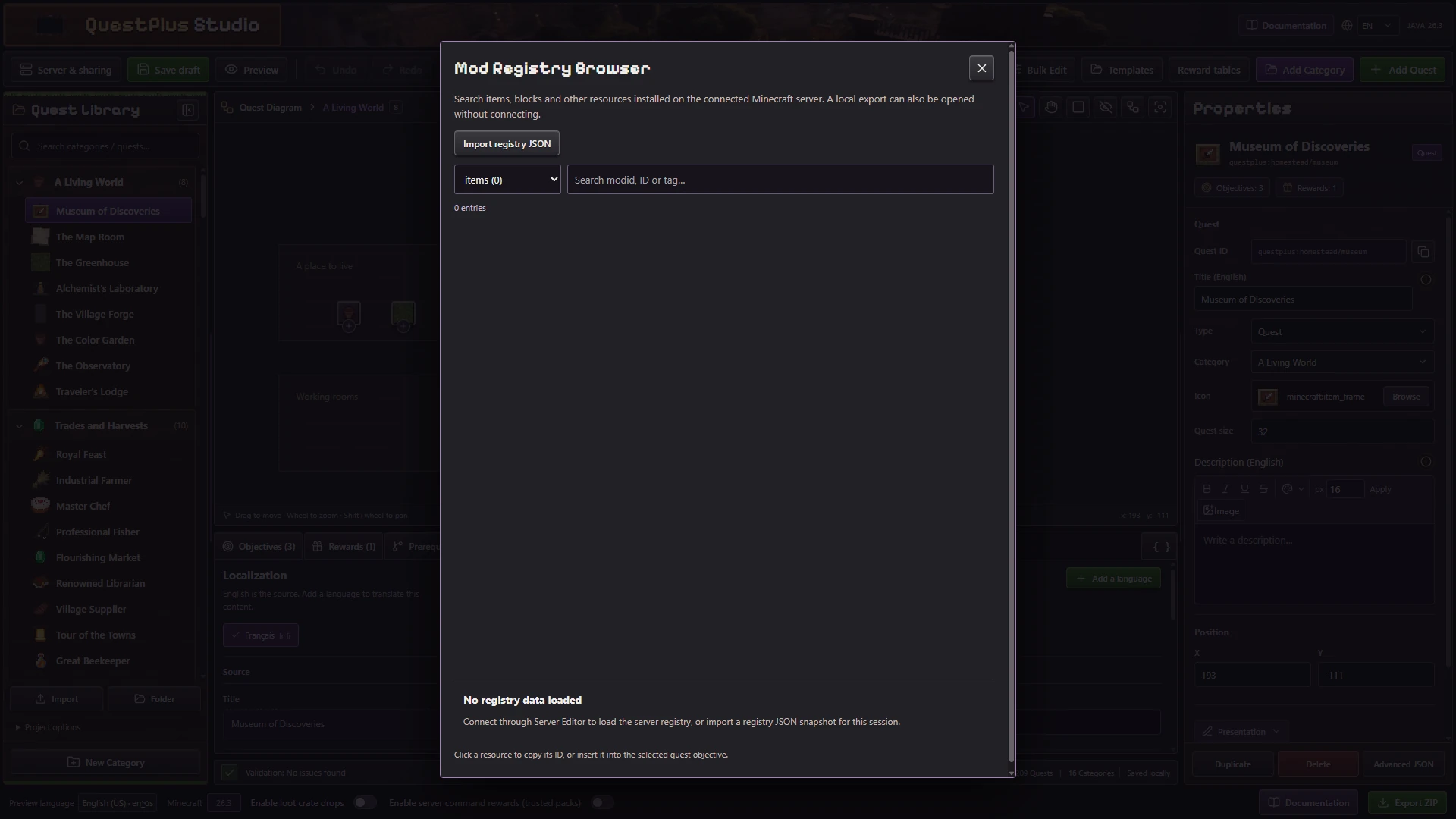
Mod Registry Browser
In Quest Studio, use Mod Registry Browser to select IDs from a connected server or imported registry snapshot. A snapshot helps authoring but cannot install mods or create gameplay handlers.
Expose an editor form
Register the gameplay event, condition or reward first. Then call registerEditorDescriptor with kind event, condition or reward, a namespaced ID, a label and a Gson array of fields.
java
JsonArray fields = new JsonArray();
fields.add(JsonParser.parseString(
    "{\"key\":\"recipe\",\"type\":\"string\",\"label\":\"Recipe identifier\"}"
));
QuestPlusApi.registerEditorDescriptor(
    "event", "example:machine_complete", "Complete a machine recipe", fields
);
Each field has exactly key, type and label. Supported types include string, integer, boolean, item, block, entity, biome, dimension, enchantment, fluid, structure, statistic, advancement and effect. A descriptor can contain up to 20 fields.
Descriptors supply data only. They never execute browser scripts and do not replace server validators. An offline project can retain extension data, but the actual server must have the matching integration before accepting it.
Stages and reusable rewards
A stage provider bridges external progression through QuestStages.Provider. Register it during initialization and read or mutate stages on the server thread.
Named reward tables let multiple quests reuse a pool. Studio stores them in queststudio-compatibility.json. The candidate registry checks references and cycles before activation. Existing granted entitlements retain their concrete outcomes when a table changes.
Need HTTP requests instead? See Quest Hub API.
Dynamic forms and compatibility
Descriptor fields support key, type and label, plus optional data-only metadata: default, numeric min/max, and options (1–30 distinct strings) for choice fields. number supports finite decimal values alongside integer. These hints are validated on the server and in Studio but are not a replacement for registerObjectiveData, registerCondition or registerReward validators. Studio never evaluates scripts or trusts values from a browser.
Example:
java
var fields = JsonParser.parseString("""
    [{"key":"rate","type":"number","label":"Rate","min":0,"max":4,"default":1.5},
     {"key":"mode","type":"choice","label":"Mode","options":["press","crusher"],"default":"press"}]
    """).getAsJsonArray();
QuestPlusApi.registerEditorDescriptor("event", "example:machine", "Machine", fields);
Unknown custom objective/condition/reward IDs remain editable as data offline, with an unavailable-extension warning. The server must have the corresponding handler before publishing. An optional Java adapter lifecycle and quest progress/events API are ready for a future KubeJS bridge, but there is no KubeJS integration or JavaScript execution today.